
Tuesday, May 1, 2012
Repurpose a Soda Bottle Into a DIY Irrigation System [Gardening]
Repurpose a Soda Bottle Into a DIY Irrigation System [Gardening]:
If you want to go out of town without your garden plants wilting from neglect, you can easily turn plastic 2-liter soda bottles into a makeshift irrigation system. More »


Cut Bread Loaves Upside Down to Avoid Squishing [Food Hacks]
Cut Bread Loaves Upside Down to Avoid Squishing [Food Hacks]:

Next time you're cutting a loaf of unsliced bread turn that loaf over and start the cut from the bottom—you'll have an easier time cutting as the bottom is softer than the crust and since you'll cut easier you can avoid squishing the bread. More »


Researchers make an RGB laser with a regular laser and quantum dots
Researchers make an RGB laser with a regular laser and quantum dots:
 The problem with lasers is, they tend to generate just a single color or light.To get more than one hue requires actually combining more than one type of laser to produce red, green and blue. But researchers at Brown University have figured out a solution to creating small RGB lasers by using colloidal quantum dots, or CQDs. The idea of leveraging the properties of the thin film isn't new, but past attempts to use CQDs in semiconductor lasers have failed because the necessary energy tends to wind up as heat instead of light. The work around scientists found was to excite the various dot sizes with a laser then filter out original light source. Unfortuneately, the solution is far from practical for use in commercial products, but it does represent a milestone in the march towards a single-material multi-wavelength laser. For more details check out the source link.
 Ars Technica |
 Nature, Brown University | Email this | Comments
Researchers make an RGB laser with a regular laser and quantum dots originally appeared on Engadget on Tue, 01 May 2012 06:06:00 EDT. Please see our terms for use of feeds.
Permalink Ars Technica | Nature, Brown University | Email this | Comments
ShopBot
ShopBot: 
The ShopBot is a low-cost CNC, or computer controlled router. Think of it as a large-scale milling machine. It is great for small-scale production runs of machine parts in wood or metal. A friend of mine used his ShopBot to cut the gears and mechanism (other than the chime) for a full-scale replica of a grandfather's Clock. ShopBots (and their kin) can also fabricate extremely detailed 3D contour maps (whole cities!), and other intricate 3D surfaces.
We have one at the design school I teach at. It can cut anything programmable like the hull plates for a full scale sailboat. On a big boat, each plate of the hull is different shape, but the ShopBot just follows its orders and spits them out ready to install. It is very accurate. Hey, you can even equip it with a pen or the like, which permits very intricate drawings. The cheapest Shopbot is the small Shop Bot Desktop for $5,000. They are getting cheaper every year, but if you only need one occasionally, you can buy time on one at shared workshops like Techshop.
-- J. Baldwin
I work at Stanford's design school -- called the d.school. We designed and made much of the furniture we used in our new building space in Google's Sketchup and machined the material using a 4' x 8' ShopBot owned and operated by Rob Bell. The process was very fast, and relatively cheap. ShopBot + Sketchup allowed us to do many cycles of design/build/test, which ultimately yielded some very refined artifacts.

I have also a Shop Bot while working with a podiatrist who practices as a foot surgeon. The folks in his practice spent a lot of time hand-crafting custom orthotics and insoles, which was very inefficient. Because of my experience at Stanford I realized that the high spindle speed of a wood router could effectively cut the medical grade foam he used in his orthotics. I modeled insoles in CAD (using Solidworks) and we purchased a 4'x8' ShopBot PRS Alpha to cut 20-30 pairs of insoles out of 4'x8' foam sheets. We eventually upgraded to a much smaller benchtop ShopBot and installed it in his practice. We reduced machining time to about 15 minutes.
ShopBot has a very strong user community and were always very responsive with tech support. The price of this computer controlled milling machine and modeling software is best of all. It would have been previously inaccessible to a private practice physician even a few years earlier.
-- Dave Baggeroer
ShopBot Desktop
$5,000
Available from and manufactured by ShopBot Tools
Sample Excerpts:
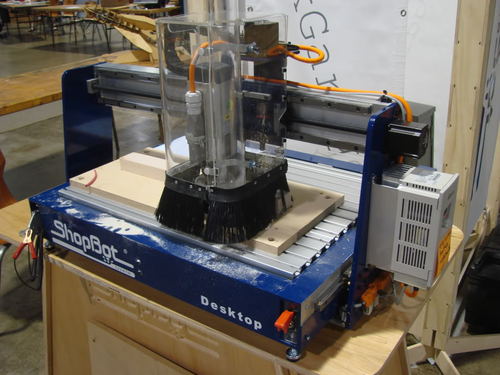


The ShopBot is a low-cost CNC, or computer controlled router. Think of it as a large-scale milling machine. It is great for small-scale production runs of machine parts in wood or metal. A friend of mine used his ShopBot to cut the gears and mechanism (other than the chime) for a full-scale replica of a grandfather's Clock. ShopBots (and their kin) can also fabricate extremely detailed 3D contour maps (whole cities!), and other intricate 3D surfaces.
We have one at the design school I teach at. It can cut anything programmable like the hull plates for a full scale sailboat. On a big boat, each plate of the hull is different shape, but the ShopBot just follows its orders and spits them out ready to install. It is very accurate. Hey, you can even equip it with a pen or the like, which permits very intricate drawings. The cheapest Shopbot is the small Shop Bot Desktop for $5,000. They are getting cheaper every year, but if you only need one occasionally, you can buy time on one at shared workshops like Techshop.
-- J. Baldwin
I work at Stanford's design school -- called the d.school. We designed and made much of the furniture we used in our new building space in Google's Sketchup and machined the material using a 4' x 8' ShopBot owned and operated by Rob Bell. The process was very fast, and relatively cheap. ShopBot + Sketchup allowed us to do many cycles of design/build/test, which ultimately yielded some very refined artifacts.

I have also a Shop Bot while working with a podiatrist who practices as a foot surgeon. The folks in his practice spent a lot of time hand-crafting custom orthotics and insoles, which was very inefficient. Because of my experience at Stanford I realized that the high spindle speed of a wood router could effectively cut the medical grade foam he used in his orthotics. I modeled insoles in CAD (using Solidworks) and we purchased a 4'x8' ShopBot PRS Alpha to cut 20-30 pairs of insoles out of 4'x8' foam sheets. We eventually upgraded to a much smaller benchtop ShopBot and installed it in his practice. We reduced machining time to about 15 minutes.
ShopBot has a very strong user community and were always very responsive with tech support. The price of this computer controlled milling machine and modeling software is best of all. It would have been previously inaccessible to a private practice physician even a few years earlier.
-- Dave Baggeroer
ShopBot Desktop
$5,000
Available from and manufactured by ShopBot Tools
Sample Excerpts:

Soften Creamy Cheeses with a Warm Water Bath to Chow Down Sooner [Video]
Soften Creamy Cheeses with a Warm Water Bath to Chow Down Sooner [Video]:

A rule of thumb for creamy cheeses like brie or camembert is that they're best enjoyed at room temperature, but when you're hungry and pull it out of the fridge, you're stuck waiting an eternity for the cheese to come to up to temp. America's Test Kitchen has a solution for us that won't ruin the cheese: a warm water bath in a tightly sealed plastic bag. It takes a fraction of the time, won't ruin the texture or flavor, and gets the cheese into your face sooner. More »


Home Heating Automation with Google Calendar [Video]
Home Heating Automation with Google Calendar [Video]:

Thought Google Calendar is just for setting up appointment reminders? Nope, you can actually remotely control and schedule your home heating with Google Calendar, as this home automation project shows. More »


Field Trips: Parque de Las Iguanas
Field Trips: Parque de Las Iguanas: 
Guayaquil (often pronounced as "Gwy-a-keel") is the largest city in Ecuador. It's a sprawling metropolis of some 4 million people, located just south of the equator and just inland from the pacific ocean.
In downtown Guayaquil, next to a little cathedral, an unassuming city park block features trees and benches, grassy areas behind knee-high fences, coblestone walkways, and gaggles of kids playing with their families. And also, green iguanas. Hundreds of green iguanas.

While formally known as Parque Seminario (Seminary Park-- again, it's next to the little cathedral), the park is better known to the locals as Parque de Las Iguanas, or Iguana Park, and the resident population of iguanas is as people-friendly as they come. The iguanas are not kept behind fences or cages; they roam freely and seem to live in the park entirely by choice. (Of course iguanas are native to the region, and the surrounding city streets are a lot less critter-friendly than the park.)


The iguanas hang out on the grass, in the trees (even the tops of the very tall ones), on the benches, and (most of all) in the walkways through the park.


There is a range of different iguana ages in the park. The young ones seemed to be better at hiding, and move a bit more quickly.
In the photo of the older iguana here, you can see something interesting if you look closely at its forehead, just above and behind the eyes: a single lighter colored scale. This is actually what is known as a parietal eye-- a "third eye," but much more primitive than the two used for vision. The parietal eye can sense light and dark above and behind the iguana's head, so that it's harder to sneak up on it from behind.

There are quite a few signs around the park telling you not to feed the animals.

Of course, there are more people around the park feeding the animals than there are signs.

And if you look around, you might notice someone selling pre-sliced strips of mango, just around the corner from the park entrance.

But as far as we can tell, everybody (except the person who requested those signs) actually seems to be doing pretty well here-- the kids enjoy feeding the iguanas, the iguanas really enjoy being fed, and the woman with the mango strips seems to be doing fine as well.

There are also plenty of signs saying not to touch the animals, but these aren't taken much more seriously. On the bright side, the iguanas have the grassy areas and trees to retreat to, and it seems likely that hanging out with the kids longer is a good way to earn more mango strips.
It's a good thing that iguanas eat fruits and vegetables, rather than children.
Guayaquil (often pronounced as "Gwy-a-keel") is the largest city in Ecuador. It's a sprawling metropolis of some 4 million people, located just south of the equator and just inland from the pacific ocean.
In downtown Guayaquil, next to a little cathedral, an unassuming city park block features trees and benches, grassy areas behind knee-high fences, coblestone walkways, and gaggles of kids playing with their families. And also, green iguanas. Hundreds of green iguanas.
While formally known as Parque Seminario (Seminary Park-- again, it's next to the little cathedral), the park is better known to the locals as Parque de Las Iguanas, or Iguana Park, and the resident population of iguanas is as people-friendly as they come. The iguanas are not kept behind fences or cages; they roam freely and seem to live in the park entirely by choice. (Of course iguanas are native to the region, and the surrounding city streets are a lot less critter-friendly than the park.)
The iguanas hang out on the grass, in the trees (even the tops of the very tall ones), on the benches, and (most of all) in the walkways through the park.
There is a range of different iguana ages in the park. The young ones seemed to be better at hiding, and move a bit more quickly.
In the photo of the older iguana here, you can see something interesting if you look closely at its forehead, just above and behind the eyes: a single lighter colored scale. This is actually what is known as a parietal eye-- a "third eye," but much more primitive than the two used for vision. The parietal eye can sense light and dark above and behind the iguana's head, so that it's harder to sneak up on it from behind.
There are quite a few signs around the park telling you not to feed the animals.
Of course, there are more people around the park feeding the animals than there are signs.
And if you look around, you might notice someone selling pre-sliced strips of mango, just around the corner from the park entrance.
But as far as we can tell, everybody (except the person who requested those signs) actually seems to be doing pretty well here-- the kids enjoy feeding the iguanas, the iguanas really enjoy being fed, and the woman with the mango strips seems to be doing fine as well.
There are also plenty of signs saying not to touch the animals, but these aren't taken much more seriously. On the bright side, the iguanas have the grassy areas and trees to retreat to, and it seems likely that hanging out with the kids longer is a good way to earn more mango strips.
It's a good thing that iguanas eat fruits and vegetables, rather than children.
Subscribe to:
Posts (Atom)